 I liked this book. Mostly because I could relate. Haven't we all been in one of those inescapable bad moods? The kind that makes us want to be thoroughly mean to strangers just because their existence annoys us? The kind that makes us feel like some great beast from within is try to rip right through our skin...no, just me? Well, I suppose Bell Hooks must know something about it too. Once again, Raschka and Hooks collaborate for Grump Groan Growl which is about a boy whose bad mood is literally a monster on the prowl that he can't get rid of. Once again, Hook's words are incorporated into Raschka's art and handwritten by the illustrator. I think Hook's actual storyline is a bit hard to understand because she writes with a strange rhythm. It's more like a poem. I'm not sure how many kids would get the figurative language of just letting their bad mood 'slide'. I read this with a first grader and, while he enjoyed the book (Hooks repeats a few of the sentences, which are nice and short and convey an idea in a single word sometimes, so he even tried to read with me the second time through), I'm 97% sure he didn't totally understand it. I think what really drew him in were Raschka's illustrations. They have this really masculine aggression to them. I don't even know how. But he uses bold colors and there's a certain angry sloppiness to them. Splotches, like someone pressed too hard with the brush or were so upset they couldn't see straight, and thus, missed their mark a few times. Who knows? But the effect is, erm...effective.
Tuesday, March 31, 2009
bad mood on the prowl
I liked this book. Mostly because I could relate. Haven't we all been in one of those inescapable bad moods? The kind that makes us want to be thoroughly mean to strangers just because their existence annoys us? The kind that makes us feel like some great beast from within is try to rip right through our skin...no, just me? Well, I suppose Bell Hooks must know something about it too. Once again, Raschka and Hooks collaborate for Grump Groan Growl which is about a boy whose bad mood is literally a monster on the prowl that he can't get rid of. Once again, Hook's words are incorporated into Raschka's art and handwritten by the illustrator. I think Hook's actual storyline is a bit hard to understand because she writes with a strange rhythm. It's more like a poem. I'm not sure how many kids would get the figurative language of just letting their bad mood 'slide'. I read this with a first grader and, while he enjoyed the book (Hooks repeats a few of the sentences, which are nice and short and convey an idea in a single word sometimes, so he even tried to read with me the second time through), I'm 97% sure he didn't totally understand it. I think what really drew him in were Raschka's illustrations. They have this really masculine aggression to them. I don't even know how. But he uses bold colors and there's a certain angry sloppiness to them. Splotches, like someone pressed too hard with the brush or were so upset they couldn't see straight, and thus, missed their mark a few times. Who knows? But the effect is, erm...effective.

a thoughtful hippopotamus is who is you
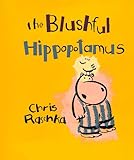 Finally, something written by Chris Rascka that I liked! The Blushful Hippopotamus is cute. It's just cute. It's about Roosevelt the hippopotamus whose sister is just evil to him. He's either really dumb or really young, but she rubs his face in every mistake he makes which causes him to blush. Finally, after enough abuse, Roosevelt asks his best friend Lombard the bird (stork?) if he really is a blushful hippopotamus. And wouldn't you know it? That Lombard knows exactly what to say to make Roosevelt's mean sister shrink (literally, she gets smaller and smaller) and his confidence swell. The best part, is that you get the feeling Lombard's being honest. He's not telling Roosevelt that he's the best Squash player in town or anything, but, rather, that he's thoughtful, hopeful, skillful, and wonderful! In the end, Roosevelt responds with a simple heartfelt thanks and he and Lombard hug. At least I think it was heartfelt. I mean, that's what I gathered from the illustrations. This book was funny for some reason. Maybe it's the sister's use of 'applesauce', 'pish posh', 'pooh', and 'it is to laugh' (whatever THAT means) in place of bul--loney...as she gets smaller and smaller in size. Maybe it's Lombard's silly sentence structures (a skillful hippopotamus is what it is you are, etc.). Really, it just kind of warmed my heart...and made me a little mad at my own friends.
Raschka's illustrations here are a lot like the ones for Waffle. The characters are blobs of colors with their bodies drawn on top.
good help makes leaving easier
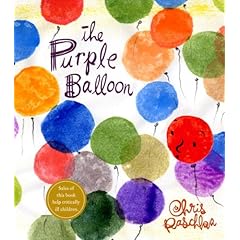 The Purple Balloon is based on odd phenomenon. It seems that often when terminally ill children who are aware of their "pending death" (as Ann Armstrong-Dailey so delicately puts it in her note before the story) are asked to draw what they feel, they draw a single blue or purple balloon floating. This sketch apparently spans cultures and religious beliefs. Researchers think it has something to do with children somehow knowing part of them will live forever. To me, this similarity is heartbreaking in its significance and prevalence. So naturally, I was expecting some deeply moving, wipe a tear from your eye, experience from The Purple Balloon. Perhaps in the end, just a single, solitary, globe sailing away into the open skies trailed sadly and haphazardly by its own string...this is not what I got. I was alarmed from the first sentence. I spent the entire story completely worried. It was not at all soothing or comforting. I mean, I don't think there's such a thing as a children's book just about dying. It's usually got some ulterior motive--generally to give the child some insight or help in dealing with the situation. I'm pretty sure that was Chris Raschka's aim too, but it felt oddly empty. I feel like he just strung opposites together to cover all his bases. Even the single sentences he accented by putting on pages by themselves just made me more scared. Now, I have to take my reaction with a grain of salt because I've never been in the situation Raschka's addressing. Maybe this is really how it goes when you're in the hospital really sick and you've left your life behind. Your friends at school, your teachers, parts of your family. Only to have them replaced by doctors and nurses, tutors. Maybe kids in these situations are meeting more people than they ever thought they would. And maybe Raschka's trying to normalize the effects or explain what all these people are for. But describing them as "making dying less hard" and "leaving easier" just seems totally presumptuous to me. Dying is never easy. Especially when you're young. And while it pains me to disagree with Desmond Tutu who gave the book a glowing review on the back cover, I think Raschka's aim was a little off with this one...or maybe I'm the one being presumptuous now?
On the bright side, sales of the book help critically ill children. And the illustrations are kind of cool. The thin color spreads he uses in the backgrounds to accent the watery balloons might mirror how transient this life, especially the lives of those facing death sooner, are...or I might have started to read way too into this book.
Monday, March 30, 2009
waffling
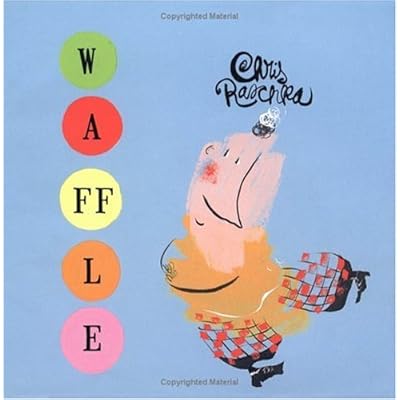 It was hard for me to imagine how a kid would feel after reading Chris Raschka's Waffle. Mostly because I didn't know how to feel after reading Waffle. I imagine I felt much like Mr. Waffle himself. A little unsure, a little lost...Ok, I'm going to be honest: I really appreciate Raschka's ability to weave text and pictures into a singular experience and all, but this book kind of creeped me out. I really think it was over my head...which is unsettling. I like that Waffle's wishy-washy-ness and timidity was apparent through the uneven text and through the way he was illustrated. Waffle's a two-tone blob with some lines for features and stubby little legs. The two best pages of the book are where the actual story occurs. Raschka takes the word 'waffle' and Waffle himself and plays with them until they've transformed into something else. 'Waffle Waffle' wobbles and stretches until it somehow becomes 'flew' as Waffle sprouts wings (really, the blob that is his body just gets wider) and flies with the last page reading 'WAFFLE WORKED A WONDER (WITHIN)'. I get that I think. He tried to step out of himself and found a beauty and liberation inside that he had no idea was there. That's fantastic. But what I really don't understand are all the different colored smiley faces leering at Waffle from the opposite pages of the book...what do they mean? Are they the world? Are they Waffle's own insecurities? Why do they form specific shapes? Why does one of those shapes look suspiciously like a swatistika (while I'm sure this was completely unintentional, it's something I noticed)? And when you take all of these elements together, just what are supposed to understand in the end? I felt oddly good after reading the book, but all these uncertainties almost made me paranoid as well. Perhaps I'm being too adult about it. I can say I really loved the artwork though. Raschka goes bold.
Saturday, March 21, 2009
a simple story of a boy who peed on a war
 Ok. Here's something you should know about Vladimir Radunsky: he is a pacifist. You may be wondering why that's important. Well, it explains his motives for writing Manneken Pis and that explains why the book doesn't make a whole lot of sense. It was completely by chance that I picked up two controversial books based on the same statue of a peeing boy in Brussels. I don't think it was by chance that I liked one way better than the other. Radunsky chooses to tell the story of the peeing boy and how he became so famous in Manneken Pis: a Simple Story of a Boy Who Peed on a War. That right there is intriguing. And I thought to myself now, how did this work out? So I started reading. I was immediately captured by the great illustrations. I would describe them as frenzied painting...or something. And so I read of a little boy who lived very happily with his mother and father until one day enemies came and ruined everything. At this point, I'm expecting a brief explanation of war. Maybe some hint at its complexities. But no, Radunsky says no one knew why they came and that perhaps it was jealousy of the town's beauty that drew them there (to destroy it). And that's it. And now all of a sudden the boys parents are gone and he's scared and there are people fighting everywhere. So he walks up to a wall and he very suddenly has the very urgent need to pee--this part was actually kind of funny because it literally came from nowhere. So he stands on that wall and he lets it fly. And somehow this little boy is able to pee on everyone and everything. Seriously. And the mean people fighting the war, instead of getting mad, laugh. They laugh themselves to sleep in fact. And in the morning they wake up in such a good mood, they stop fighting. And look!--are those the boy's parents coming up the lane there? And yes, they all lived happily ever after...so like, I get the message. And I get the humor. It really was kind of funny. But I just don't get the writing. I just think Radunsky could have done more. It feels choppy and incomplete. I guess he wasn't kidding when he said he'd be telling a "simple" story.
roy, silo, & tango
 And Tango Makes Three. Ah, I've been meaning to read this book for months. I've heard so much about it. how inappropriate it is, how it's not suitable for children. And you know what? Yeah, it's a sensitive subject but, like...they're penguins. Are we seriously trying to shelter our children from the taboo and potentially dangerous love of two penguins? Gosh, when I finished this book, I just kind of sat there. I thought it was so well-done (although perhaps the message was a little obvious). We pretty much just get the honest, observation-based account of the behavior of two male penguins in the Central Park Zoo. Of course, the authors make sure to compare everything in the book so that we understand that Roy & Silo are comparable to any other couple, any other family. I like that Richardson and Parnell don't give any other name to what transpires between Roy & Silo but love. That kind of keeps it simple and keeps focus. These two little penguins try so hard to be like everyone else but they just can't. I think that's an important point somehow. It's not as if the author is saying that homosexuality is the same as heterosexuality, but, rather, another thing that makes us beautifully diverse. It isn't until the zookeepers give the two penguins Tango's egg that they are able to become a family. And in the end I think the reader's supposed to see that a couple like Roy & Silo can be a functioning/contributing and successful part of society if given the chance. And that Tango's family does and needs the same things as everyone else's, even if it is a little different. There's also some neat non-fiction information in the back of the book about the penguins and their home in the zoo.
Oddly, the thing I was most unimpressed with about this book were the illustrations by Henry Cole. They're certainly not bad by any means, they just didn't wow me. My eyebrows raised even higher when I read his little bio in the back flap that I think described him as something like "an extremely incredible and versatile" illustrator or something. But Tango is quite adorable. There's no arguing with that.
let girls go running free
 I honestly don't see why this book is controversial...it wasn't even that interesting. In fact, it was a little boring. It's pretty much just an illustrated, hand-written poem about little Black girls and the beauty of their hair. What's wrong with that? And it was written by Bell Hooks who has, at times, been credited with writing one of the most influential books of the 20th century, Ain't I a Woman? Hooks (real name: Gloria Jean Watkins) is a very accomplished writer, educator, activist, and feminist. Much of her work deals with class, gender, a race in art, education, and society. She's been a professor at some of the most prestigious universities in the country. I suspect the controversy has something to do with the title. 'Nappy' getting tossed into the fray often gets people up in arms. But she's not reckless with her words. And she's certainly not reckless in Happy to Be Nappy. The title is probably the most controversial thing about this book. I'm pretty sure she picked these words because they rhyme and they're simple. It's for children after all. The most interesting thing about this book, besides the author's accomplishments, is the illustrator. Chris Raschka. I just find them to be a funny pair. Chris Raschka has written his own award-winning books and I'd heard of him but not Hooks. Yo! Yes? by Raschka is one of my favorite books to read with kids because you can do so much with it. He chose to use "color washes with bold strokes" for Happy to Be Nappy. They're definitely a little abstract. I liked how he also depicted girls of different shades of brown which I feel like I don't see a lot. The hair is where the bold strokes come in. It shows a real thickness. The paper the book is on is a little coarse too, matted, unfinished. Subtly anyone?
But I have to say, I'm still not sure what a "girlpie" is. Must just be a term of endearment Hooks is fond of using.
Edit: it occurs to me after thinking about it again that this book is perhaps not appropriate for classroom use unless you teach at a predominantly Black school or can somehow communicate to your children the history of the word "nappy". At the same time, though, I'm torn because nappy hair is a reality. Sure, it's maybe not the most PC term but I've used it all my life and I think it's good for children to be exposed to something outside of what they know. I just imagine the little girl(s) in a school that is predominantly different from them being self-conscious about the way they look and it seems silly to keep a book that might offer some relief away from them. I guess this brings up the age-old question of where to draw the line.
Subscribe to:
Posts (Atom)